
Establishment
The Office of the Sovereign (German: Das Souveränes Büro) is the executive office of the combined offices of the German Emperor, Chancellor, Supreme Warlord, head of the Party, and the numerous other titles held by the person in corporation of Hendrik Baumer, the Emperor of all Europe. Established shortly after the accession of Hendrik Baumer in 1921 as German Emperor, the initial size of the office was limited to just the Emperor, the Prince Regent, the Lord Commander (along with the members of the Sovereign Crown Corps), and the Grand Architect, to coordinate all policy coming from the Crown towards its various ministries and other bodies.
Twenty years later, the Office would see itself expanded dramatically as wartime and administrative necessitation required more personnel. In 1941, with the appointment of a Hand of the Emperor, a Royal Treasurer, a Royal Comptroller, and various other staff officers, the Office would see its presence enhanced throughout the Imperial Capital. The Office's wartime expansion also included the Plenipotentiary of War and the Order Marshal. Hugo Bähr has served as Order Marshal since 1941.
Kaiser
-
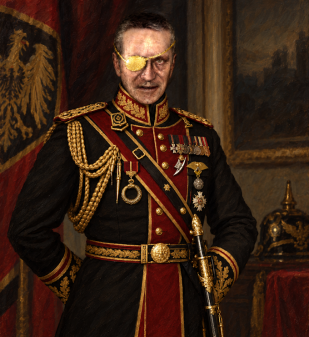
Hendrik Baumer
The German Emperor (Deutsches Kaiser), Holy Roman Emperor, Autocrat of all Europe, and Defender of the Faith, is the most powerful individual on Earth. Commanding both the largest and most technologically advanced military, a massive bureaucracy, and territorial control over half of the planet, Hendrik Baumer, formerly a Lieutenant General (Generalleutnant) and the Duke of Brandenburg, was crowned on January 22, 1921, in the Berlin Cathedral by Papal Legate Lukas Sommer, also the Archbishop of Germany.
Hand des Kaisers
The Hand of the Emperor (Hand des Kaisers) is the principal personal officer of the German Emperor and the highest appointed office beneath the Emperor. Established to serve whatever function the Emperor requires, the office has gone vacant for great periods of time. The Hand serves as the Emperor's primary instrument of governance, holding responsibility for the day-to-day affairs of the Crown and oversight of the Empire, the Royal Household, and all Imperial institutions. The Hand is head of the Royal Household and oversees the other personnel within the Office of the Sovereign. Since August 1941, the position has been occupied by Clauß von Lindau, who concurrently serves as Lord High Gardener and Honorary President of the German Bar Association.
Erzprotektor
The Arch Protector (Erzprotektor) is the chief military aide to the German Emperor and the highest-ranking uniformed officer in the German Empire. Responsible for the functions of the office of Plenipotentiary of War, the Arch Protector coordinates the war effort between the Emperor and the Imperial War Authority. The sole holder of this title has been Gabriel Pfundmacher, concurrently serving as Knight-Marshal of the Order of the House of Baumer.
Prinzregent
The Prince Regent (Prinzregent) is the heir presumptive to the Imperial Crown. While not often entrusted with a great deal of administrative matters, the officeholder remains influential due to his status as the heir. The current Prince Regent is Landa Vought. In June 1944, at the Emperor’s direction, Prinzregent Landa Vought negotiated the conditional surrender of the United Kingdom of Great Britain and Northern Ireland. On return from the negotiations, he was attacked by Luftwaffe fighter-bomber squadrons who mistook him for an Irish Republican Army officer. He survived, but remains debilitated, conducting his work from a golden wheelchair for which he has become famous.
Prätor
The Prätor is the Crown Official entrusted with the oversight of the Church and all religious affairs within the Empire. Since 1921, the Prätor is Luka Sommer, who holds the simultaneous title of Archbishop of Germany, as appointed by Pope Benedict XV.
Lord Protector
The Lord Protector of North America is the seniormost Crown official in the North American protectorate. The office is established in the Constitution of the Imperial American Protectorate of 1947. The Protectorate Act of 1948 further defines the Lord Protector’s status as head of State, Government, the White Rose, and the Armed Forces within the Protectorate. He is also styled as Archduke of New England, Duke of New York, Count of Manhattan, Warden of the Western Hemisphere, Overlord of the Empire Overseas, and Defender of the Faith. Since 1947 the Lord Protector has been Alexander Washington.
Lord Commander
The Lord Commander of the Drachengruppe (Wachkommandant der Drachengruppe) is the chief of the Emperor's individual guard detachment, the Drachengruppe. He is entrusted with the task of selecting and training the members of the Drachengruppe in their hallowed duties. Since 1941, the Lord Commander has been Lawson Kühn.
Großarchitekt
The Grand Architect (Großarchitekt) is the Crown Official responsible for the construction and oversight of Imperial properties and cities, namely the reconstruction of Berlin following the Spartacist Uprising. The Grand Architect also designed the cities of London and New York to an exacting specification after their being nearly destroyed in the Second World War. The Grand Architect since 1941 has been Robert Hofbauer.
Souveränes Kronkorps
Within the ranks of the Souveränes Kronkorps, the Lord Commander Wilhelm Winter and his trusted second-in-command, Lawson Fuchs, stand as the visible pillars of strength and skill. However, the true strength of the Kronkorps lies in the anonymity and unwavering dedication of the other five members, whose identities are shrouded in secrecy and known only to a select few. Within the clandestine world of the Souveränes Kronkorps, the Lord Commander reigns as a figure of awe and reverence, his name whispered in hushed tones among both allies and adversaries alike. Wilhelm Winter, a larger-than-life presence whose very aura commands respect, epitomizes the embodiment of strength, wisdom, and unwavering loyalty to the Kaiser. Born of noble lineage and steeped in the traditions of martial prowess, Winter rose through the ranks of the Kronkorps with unmatched ferocity and determination. His towering stature and piercing gaze inspire both fear and admiration, as he leads his elite warriors with an iron will and unyielding resolve.
Yet, for all his formidable presence, Winter remains an enigma, his past shrouded in mystery and intrigue. Little is known of his origins or the trials that forged him into the legendary figure he has become. Yet, in the presence of the Lord Commander, there is an undeniable sense of destiny—a feeling that he alone holds the key to the fate of the German Empire. By his side stands Lawson Fuchs, the shadow to Winter's light, a figure of quiet menace whose lethal prowess belies his unassuming appearance. Small in stature but mighty in skill, Fuchs moves with the grace of a panther, his every movement calculated and precise. Though his voice may be soft, his words carry the weight of authority, commanding the respect of all who serve under his command.
Together, Winter and Fuchs form a formidable duo, their complementary strengths and abilities making them a force to be reckoned with on the battlefield and beyond. Where Winter leads with strength and determination, Fuchs follows with cunning and guile, his keen intellect and strategic acumen serving as invaluable assets to the Kronkorps' mission. These silent guardians, chosen for their exceptional abilities and unswerving loyalty, operate in the shadows, their presence felt but seldom seen. Each member embodies the core values of the Kronkorps—duty, honor, and sacrifice—and stands ready to defend the Kaiser with their lives. Their training is rigorous and relentless, honing their skills in combat, espionage, and reconnaissance to perfection. They are the unseen hands that shape the destiny of the German Empire, navigating the treacherous currents of court intrigue and political machination with unparalleled precision and efficiency. Though their names may never be spoken aloud, the impact of their actions reverberates throughout the halls of power, as they move silently and swiftly to protect the Kaiser from any and all threats. From thwarting assassination attempts to uncovering plots of treason, the Kronkorps spare no effort in ensuring the safety and security of their sovereign.
Their loyalty knows no bounds, and they are prepared to lay down their lives without hesitation in defense of the crown. For them, duty is not merely a obligation, but a sacred calling—a testament to the timeless values of honor, loyalty, and sacrifice that define the soul of the German nation. As the silent sentinels of the Kaiser, these unknown heroes stand as guardians of the realm, their unwavering resolve and selfless dedication serving as a beacon of hope in a world fraught with danger and uncertainty. And though their names may fade into obscurity, their legacy will endure as a testament to the indomitable spirit of the German people and the enduring strength of their nation.